
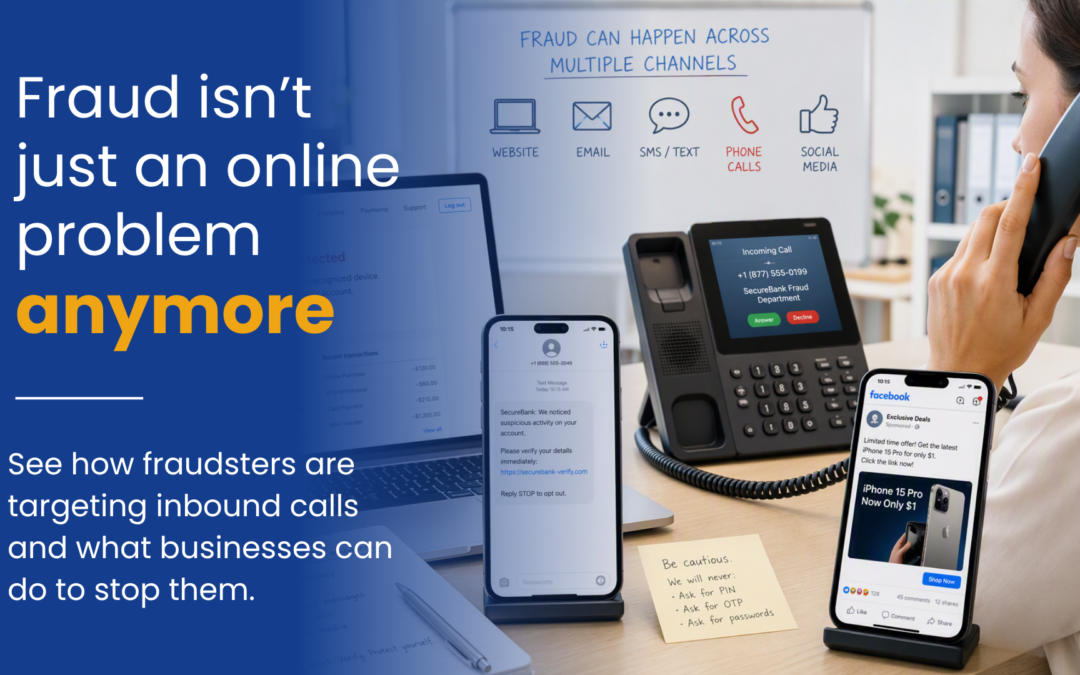
Running a contact centre means that you are already well aware of the potential for fraud. You see the account takeover attempts, the policy‑holder impersonation, the questions that are ‘just a bit too interested’ in process and data, and so much more. What’s changing is the scale and technical sophistication of those attacks, and the fact that inbound phone lines are now a target, not just a customer service channel.
Inbound Fraud Shield (IFS) is an AI and machine‑learning technology developed to act as a first line of defence for your contact centre. It sits in front of your telephony network layer and monitors incoming calls in real time. Using a mix of real-time information and a large-scale database of known fraudulent numbers, it scores the risk of incoming calls and makes decisions before the call ever reaches an agent or a self‑serve platform. The database is constantly updated with the latest information, making sure it can fulfil its goal of letting genuine calls through whilst managing the potentially fraudulent ones.
Spotting patterns humans can’t see
Inbound Fraud Shield works in partnership with the agents, both doing what they do best. Humans are good at spotting when ‘something feels unusual’ when they’re having a conversation, which is rooted in intuition and human traits that AI will never be able to replicate. However, what the agents can’t easily see is what the same caller did last week, or how many times similar calls have hit your IVR today. This is where IFS steps up – it watches for larger and more disparate patterns spanning your entire inbound environment, such as:
- Repeat calls from the same origin, even when the caller is withholding their number or rotating through multiple numbers.
- Bursts of calls at unusual times or volumes, which can indicate bot dialling or systematic probing of your menus.
- Combinations of caller characteristics and call outcomes that are strongly associated with past fraud attempts.
By automatically identifying and scoring these patterns, the IFS helps protect you from bad actor campaigns and behaviours that affect your entire contact centre network.
Protecting auto‑attendants and self‑serve platforms
As the first point of contact for all inbound calls, IFS is helping protect more than just your agents. Increasingly, fraudulent activity occurs before a human ever picks up the phone. IVRs, AI and self‑service menus are being targeted in order to mine personal or policy data, test stolen details or learn how your security processes and functionality work. For example, an insurance contact centre might require policy numbers, dates of birth, partial address details, or payment‑related information, which is exactly the information fraudsters need for later fraudulent attempts.
Not only does Inbound Fraud Shield protect your systems from attacks and agents from stress and frustration, but it’s also frees up service for genuine callers, allowing you to provide an exceptional customer experience.
Flexible call routing based on risk
Inbound calls are ranked on a likelihood of risk, and, depending on the perceived risk, are routed to different destinations as defined by the contact centre leaders.
For example, you might like to route calls like this:
- ‘High‑risk’ calls are automatically cut off.
- ‘Medium‑risk’ calls are routed to a specialist fraud or security team, or to senior agents trained to handle the extra verification required to ascertain whether they’re valid or not.
- ‘Low‑risk’ calls continue in their normal journey with no extra friction.
This flexible call routing ensures you can be thorough when it comes to fraud without impacting legitimate customers who might be contacting you about stressful or time‑sensitive issues.
Giving agents the right information at the right moment
For an extra level of agent support, for those calls which are ‘low risk’, but might require some additional verification, Inbound Fraud Shield can give a warning before connection – maybe a flag on the agent desktop or a subtle cue tone before connection, depending on your setup. This kind of assistance can give the agent the confidence to listen to their gut when a call doesn’t seem right and to escalate it immediately if required.
IFS won’t replace human decision-making, but it will support it with additional information so your agents are more informed when making decisions.
Giving managers the right information and reporting
For compliance, audit and risk, and contact centre operations teams, understanding the numbers is vital to keeping the business safe. Inbound Fraud Shield keeps full records of all flagged calls, what risk they were perceived to be and how they were handled. This gives clear visibility of:
- How much unwanted traffic is being filtered out before it enters your telephony estate.
- Whether there are patterns of suspicious activity at certain times, or with specific campaigns.
- Which workflows and routing selections are most effective.
From a reporting and regulatory perspective, you can also demonstrate that you’ve implemented solid end‑to‑end fraud‑prevention strategies.
Freeing up space for genuine customers
Fraud and nuisance calls are far more than a security issue; they impact productivity throughout the organisation. Every agent spending time dealing with a spam call or a probing fraudster is a time not spent helping a genuine customer. That wasted effort translates into longer wait times, higher handle times and pressure on staffing levels.
By stopping a significant proportion of unwanted calls before they reach your agents, Inbound Fraud Shield helps free up your agents to focus on real customer needs. That means better service metrics and a less frustrating working environment.
A system that keeps getting better
Understanding and being able to protect yourself against it is an ever-moving feast. Tactics change, technology evolves, and new attack strategies appear all the time. Because Inbound Fraud Shield uses machine learning, its detection abilities improve as it sees more traffic and learns from new behaviours. Combined with continuously refreshed threat feeds and databases, that means your protection develops alongside the fraud landscape rather than standing still.
For contact centre leaders, the real value is that you’re not buying a static set of rules. You’re implementing a system that adapts to your business and your risk environment.
Protect the conversations that protect your business. Contact NSL today to learn how Inbound Fraud Shield can help defend your contact centre against fraudulent calls.